Twigs.
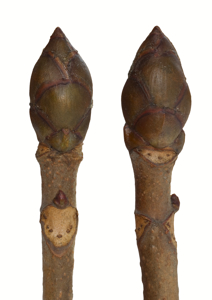
Left view of bud shows 'horse-shoe' leaf scar.
Right hand view shows view of parallel leaf scars.
Tree ID - Tip 5
Only a few trees have parallel side buds (ignoring the 'terminal bud' at the end of each twig), which means they grow opposite each other on both sides of the twig. Common trees we see in Vancouver such as Maple, Ash, Dogwood and Horse Chestnut (shown here) all share this characteristic. This distinction makes winter identification of these trees a bit easier.
Horse Chestnut buds are big and sticky and have large leaf scars which look a bit like a horse-shoe, hence the name (maybe).
To see them live - head west along 14th Ave from Arbutus.
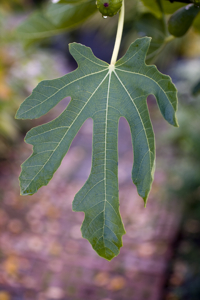
Beautiful hand of fig
Tree ID - Tip 4
Fig tree leaves are really distinctive and there are loads growing and fruiting all over Vancouver. Once you make note of the leaf shape they are easily remembered. Many fruit in summer, but unless it is a very hot one, they don't always ripen. You can find one in the Cypress Community Gardens (see map).
Read more about Fig Trees on wikipedia
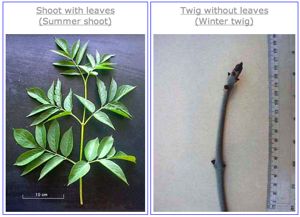
Online guides can aid identification
Tree ID - Tip 3
There are some useful online tree identification tools. Ones that use either/or keys to help deduction are a useful addition to field guides. Check out this one, but remember that common names of trees vary from country to country, so always make note of the botanical name (usually in Latin) and cross-reference it with your own field guide. Leaves are a great place to start when identifying a tree, but shape of tree, flowers, buds, bark and twigs all help too.
http://www-saps.plantsci.cam.ac.uk/trees/index1.htm
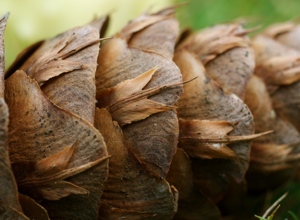
Douglas Fir cone
Tree ID - Tip 2
Douglas Fir (Pseudotsuga menziesii) must be the easiest conifer tree to identify because it has very distinctive three-forked bracts between the scales on its cones. We think it looks like a mouse's back legs and tail. What do you think?

Beech tree trunk
Tree ID - Tip 1
People often say you can recognise a Beech tree because its trunk looks like an elephant's leg. What do you think? You will find this one at the northern end of Trafalgar St at Point Grey Road.
Watch this space for more tree identification tips.
.